


The Grand Paris Express numbers are impressive. 200km of new metro lines, 68 stations, to serve 3 million travellers per day. Especially when the timescale from design to delivery is just 21 years. Construction works began in 2016, and part of the project, the extension of metro line 14, was already in service for the 2024 Olympics.
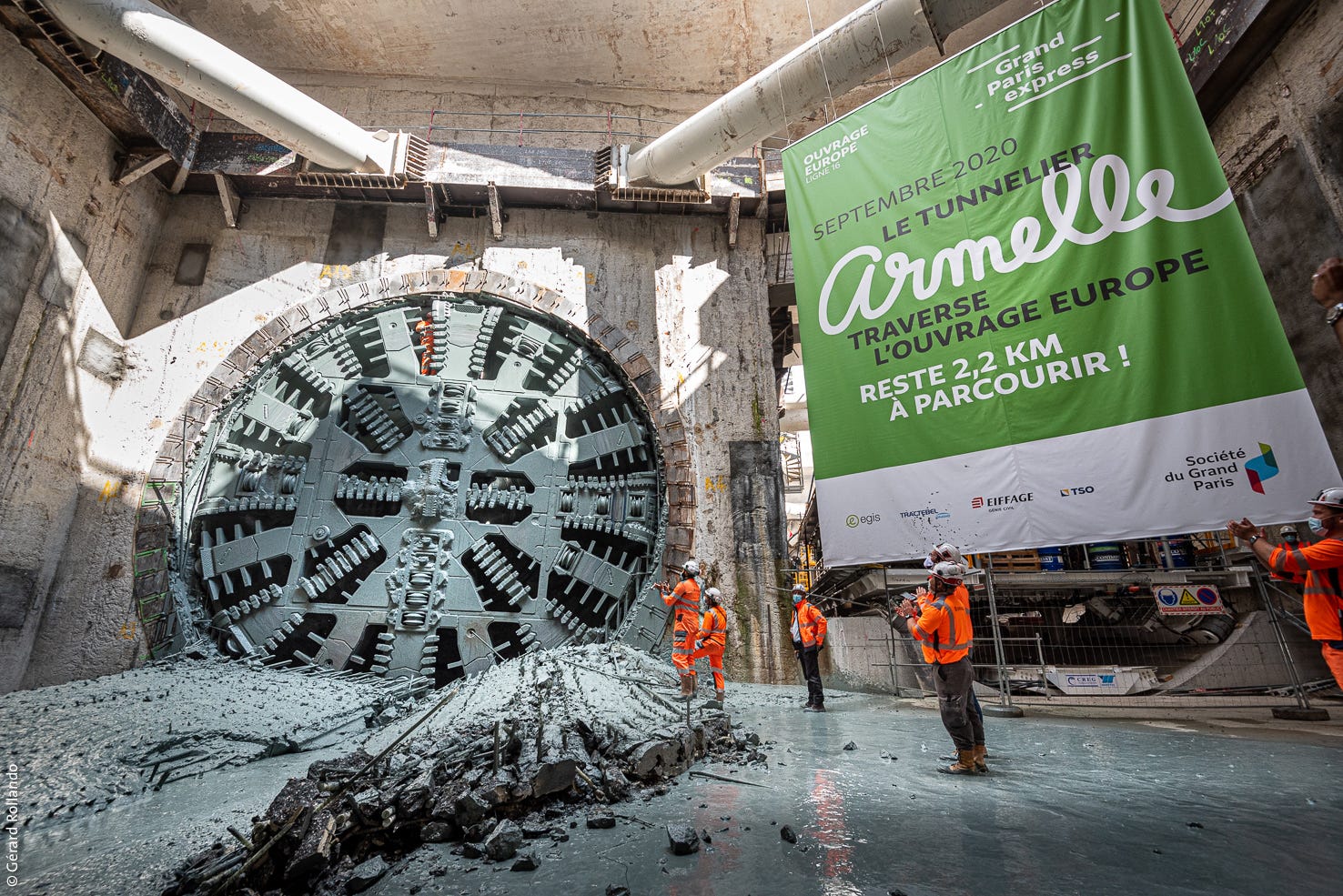
How does France deliver public goods on this scale? The key to their success is setting up a dedicated public delivery company, to focus efforts and accountability. For the Grand Paris Express, the Société du Grand Paris (Greater Paris Company) was created in 2010.
Just as important are the tools at the delivery company’s disposal, especially for land assembly. The Société du Grand Paris was able to draw on several methods: land banking, agreed purchase, easements, right of substitution, and compulsory purchase.
Five core mechanisms for land assembly
Land banking
Public land agencies are created to acquire and hold property in anticipation of future infrastructure projects. Early public land assembly allows the state to capture land value increase generated by transport improvements. They might buy and hold property for a decade, covering debt costs with continued operation. The Paris region has a public land agency, Établissement public foncier Île-de-France (EPFIF). It works alongside the Grand Paris Express, banking land in station area perimeters for housing and redevelopment.
Public utility easements
For works more than 15 metres below ground, a servitude d’utilité publique (public utility easement) avoids the need to acquire land. The easement is formed by a public order, following a parcel-level enquiry, and is a limitation of the owner’s right to use or develop their property. Property owners are compensated based on a fraction of the surface land value according to depth - roughly 6 to 8 percent of surface value at 15 to 20 metres, falling to 2 to 3 percent at 30 to 40 metres, with further reductions for water table position and other factors.
Pre-emptive right to purchase
What happens if the owner of a property in the zone of an infrastructure project puts the property on the market? Before the contract is signed, the public authority can exercise a droit de préemption (right of substitution) and step into the role of buyer. Not great for the buyer who has lost out on a purchase despite their efforts. But it does ensure that a development company like Grand Paris Express has first refusal on property in the path of significant infrastructure projects.
Compulsory purchase
By issuing a déclaration d’utilité publique — declaration of public utility — the State can certify that a project is of sufficient public interest to justify compulsory acquisition of private property. The expropriation process begins with an administrative phase including an independant enquiry, environmental assessment for larger projects, and parcel-level assessment. These steps are followed by a judicial phase where a judge issues an expropriation order and, if not already agreed, sets the property owner’s compensation.
Acquisition à l’amiable
Acquisition à l’amiable — negotiated, voluntary purchase — is the baseline for all French land assembly. Any public or private body with a mandate to acquire land may approach owners directly. There is no statutory obligation to attempt negotiated purchase before invoking pre-emption or compulsory purchase, but it is common practice and is often cheaper and faster. Price is typically informed by valuation data from France Domaine.
Benefits
With land banking, the public purse, through land agencies, captures the initial uplift in value, at an early stage in the development of an infrastructure project. This ultimately reduces the cost of delivering transport and utility projects.
Public utility easements are an administrative procedure, not requiring any legal process (unless the property owner objects on legal grounds). It is an administrative process on foot of an order from the Prefect - the national government’s regional representative. While the owner may object, whether on grounds of compensation or impact of the works, the process requires no change of property title.
How this differs from other countries
In Britain, Ireland, and most of North America, planning consent and compulsory acquisition are bundled into a single decision: a Development Consent Order in the UK, a Railway Order in Ireland. The infrastructure client cannot assemble land until that decision is granted, and cannot break ground until any judicial review is resolved.
The French system does not eliminate the risks around permitting. But it does separate these from the land assembly risks. French land agencies, with patient capital, can bank land long before authorities issue permits or make declarations of public utility.
Legal challenges
There is still friction in French land assembly. In practice, a court may be hearing legal challenges related to one part of a line while contractors have already broken ground on another section.
An example from the Grand Paris Express: in June 2025, the Tribunal Administratif de Montreuil annulled the transfer order (arrêté de cessibilité) for two parcels on the future Ligne 15 Est. The houses had already been demolished. The Société des Grands Projets (the Société du Grand Paris renamed as of 2023) is appealing.
In their book Les naufragés du Grand Paris Express (The Shipwrecked of the Grand Paris Express), Anne Clerval and Laura Wojcik capture some of the local dissatisfaction with the transport and urban regeneration project.
The book gives the perspective of small business owners, tenants and homeowners uprooted to make way for new stations. Readers get an insight into communication delays, lack of accountability due to delivery company outsourcing, and mistrust regarding the company’s approach to negotiation and compensation.
There’s no doubt that many business owners and residents are disrupted when building 200km of metro line and 68 stations. Nonetheless, from the point of view of getting infrastructure built, the six land assembly mechanisms outlined here are at the root of what’s impressive about the French approach: delivery is fast while design quality, and build quality, are not just maintained, they’re excellent. All while complying with demanding procurement and environmental rules.
This excellence, in quality and time-to-completion have a lot to do with the land assembly toolkit available to French public agencies and delivery companies. At the early stages, public land value capture drives savings that can fund build quality. Later on, tools like public utility easements and pre-emptive right to purchase provide spare a lot of time and legal costs.