


France’s public finances are back in the financial news, with borrowing costs above 4%. On 1 October the government presented a 2027 budget seeking €43 billion in new deficit-reduction measures, to bring the deficit down to 5% of GDP.
Against that backdrop, a note published this month by France’s Council of Economic Analysis (Conseil d’analyse économique, CAE) offers useful insight. The CAE is a panel of academic economists whose members are appointed by the Prime Minister’s office. For the first time since 2014, the full Council has signed a joint economic strategy for France.

The note is organised in two parts. The first covers France’s productive and social model: education, productivity, employment, poverty and the public finances. The second covers resilience to climate, trade and geopolitical shocks.
It makes eight main recommendations, backed by accompanying thematic papers. The proposed reforms would be funded by reallocating existing budgets, so would not worsen the deficit.
French debt in context
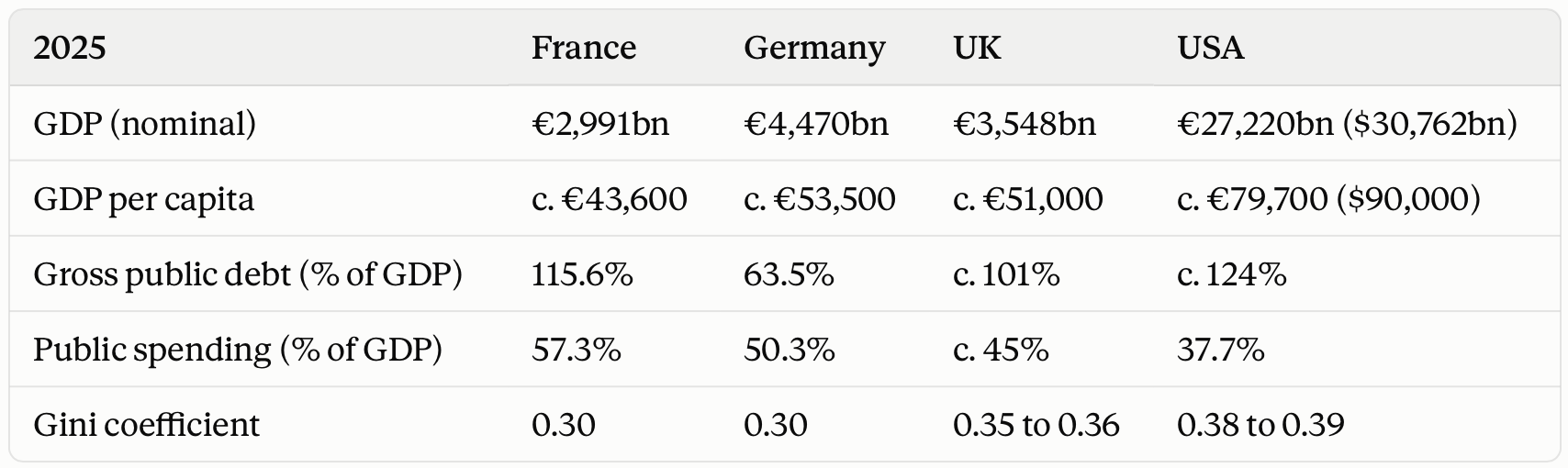
France’s GDP was €2,991 billion in 2025, about US$3.38 trillion. Public debt stood at 115.6% of GDP at the end of 2025, below the United States’ 124% but well above Germany’s 63.5% and above the UK’s 102%.
While the US has a higher debt, France has the highest public spending of the four as a percentage of GDP: 57.3% in 2025, against 37.7% in the US. Of the €1,714 billion in public spending in 2025, €771 billion was social benefits, such as pensions, paid to households.
The CAE’s core concern is a structural excess of public expenditure over receipts. Excluding interest and the effects of the economic cycle, France’s deficit stood at 2.1% of GDP in 2026, about €60 billion: even in normal times, spending consistently exceeds revenue.
Its answer is a €125 billion correction in the annual public balance by 2032 with around half delivered in the first two years. That’s equivalent to about 4% of GDP and a little over 7% of public spending.
Reforms for growth
The Council of Economic Analysis note starts with proposals for growth-enhancing reforms. On education, it would reallocate about €4 billion a year, freed up by falling pupil numbers, to raise attainment at the end of lower secondary school (age 14 to 15) by a full year of learning within a decade.
On productivity, it blames France’s divergence from the United States chiefly on slow diffusion of digital technology. Labour productivity grew by 0.8% a year in France between 1995 and 2025, against 1.7% in the US. Generative AI risks repeating the pattern: 28% of French employees use it at work, against 43% in the US.
The Council proposes a France 2040 programme worth €6 billion a year for ten years, extending France 2030, the state’s investment plan for strategic sectors such as decarbonised energy, industry and transport. A separate policy to spread technology among small and mid-sized firms would receive its own budget of €600 million a year.
On employment, the note proposes scaling back the €77 billion a year in general relief on employer social contributions, now concentrated on minimum-wage jobs. The Council proposes directing part of the savings to support employment of young people, older workers and the long-term unemployed. Labour-intensive sectors such as construction would be affected by any change.
From carbon pricing to risk management
From 2028, the EU’s expanded emissions trading system (ETS2) will put a carbon price on fuel for heating buildings and for road transport. The CAE wants it to sit on top of France’s existing carbon tax on fossil fuels (contribution climat-énergie), with a significant share of the roughly €7 billion a year it should raise in France by 2030 returned to vulnerable households as visible cash transfers.
For new construction, the direct effect is limited. France’s building-carbon regulation, RE2020, has already pushed gas heating out of most new homes, and cement and steel are covered by the EU’s original emissions trading scheme. The cost of ETS2 will fall mainly on haulage and on site machinery, as the expanded scheme also covers fuel combustion in the construction industry.
The larger effect of ETS2 is on existing buildings. Higher running costs for gas and oil-heated stock strengthen the case for renovation. (Renovation and maintenance already accounts for 60% of building activity.) The Council also wants better evaluation of renovation subsidies, including MaPrimeRénov’ and the energy savings certificates scheme funded through energy bills. The proposal is for the schemes to be assessed on their cost per tonne of CO₂ avoided.
Climate adaptation is where the CAE note goes furthest with regard to construction. It calls for adaptation to become a pillar of climate policy centred on prevention. The natural disaster insurance scheme (CatNat) is funded by a flat surcharge on property insurance premiums, regardless of risk. The Council would raise it gradually, spend more on prevention for existing buildings, and introduce a price signal for new construction in risk zones: the reform would make it costlier to build where risk is high. The note leaves the mechanism unspecified, but higher insurance charges for buildings in these zones would be the most direct route.
The note also calls for updated flood risk prevention plans, stricter construction standards where buildings are exposed to flooding or to subsidence from shrinking and swelling clay soils, and planning for relocation where risks recur. Passive measures such as insulation and solar shading come first, with air conditioning accepted in schools and hospitals. With 47% of French homes exposed to at least one climate hazard, the potential workload is considerable.
Taxes, inheritance and savings
Box 1 of the Council note gives orders of magnitude for the budget adjustment options. The Council stresses that these are illustrations, not recommendations. For the property sector, two stand out: reinstating the residence tax (taxe d’habitation) on main homes would raise €22 billion, and raising corporation tax from 25% to 33.5% about €12 billion.
Two recommendations concern how wealth is passed on and invested. The first would tighten the Pacte Dutreil, a relief that exempts 75% of the value of business shares from gift and inheritance tax. The cost to the public budget rose from €1.2 billion in 2020 to €5.5 billion in 2024, with 1% of recipients taking 65% of the benefit. The CAE would limit the exemption to operating assets, which matters for family firms holding property.
The second recommendation would steer funds from France’s main long-term savings product (assurance-vie), now largely invested in bonds, towards equities and long-term assets. The Council’s aim is financing innovative firms.
Where a spending freeze would bite
Public works is the part of French construction most exposed to public budgets. Two-thirds of the sector’s activity comes from public clients, including 42% from local authorities alone. That reflects local government’s central role in public investment: municipalities, departments and regions accounted for 53% of all French public investment in 2023, €66 billion out of €123.2 billion, a figure that covers all their capital spending, not only public works.
That’s why contractors will take note of the CAE’s illustrative five-year freeze on local authority spending, worth around €19 billion a year. Public works activity is already weakening: the national public works federation expects a 3.2% fall in 2026, with work for local authorities down 6%. A freeze on central government spending would add to the pressure on infrastructure investment.
Housing, which accounts for over 60% of building activity, is less directly exposed to public budgets than public works. Social housing in particular is largely financed through loans drawn from regulated household savings such as the Livret A. Channelled through the Caisse des Dépôts, these loans amounted to €22.9 billion for social housing and urban regeneration in 2025, helping finance 108,000 new social homes out of 270,000 housing starts last year.
The trade-offs ahead
The note from the Council of Economic Analysis arrives at a moment when France’s public finances are under pressure from rising bond rates. The Council’s contribution is a set of recommendations that pair a credible fiscal consolidation with growth-focused reforms. It also makes the trade-offs explicit: even high-return measures cover only a fraction of the adjustment needed. Several levers will need combining.
To weigh up the trade-offs yourself, you can test your preferences on the Council’s budget simulator at simulateur-budgetaire.netlify.app.