


Despite an abundance of low-carbon electricity, France has until recently lagged its neighbours in data centre capacity. It now sits third in Europe, behind the UK and Germany, with somewhere between 322 and 350 operational centres depending on how you count them. The French government wants to climb that ranking. Local communities want the opposite.
Most existing capacity is concentrated in two places: Paris, and Marseille, the landing point for submarine cables linking Europe to Africa, the Middle East and Asia. Digital Realty’s MRS3 data centre opened its first phase in Marseille in June 2020, housed in a former WWII submarine base in the port. The €140 million conversion delivered a 16.5 MW facility across roughly 7,100 m² of server space.
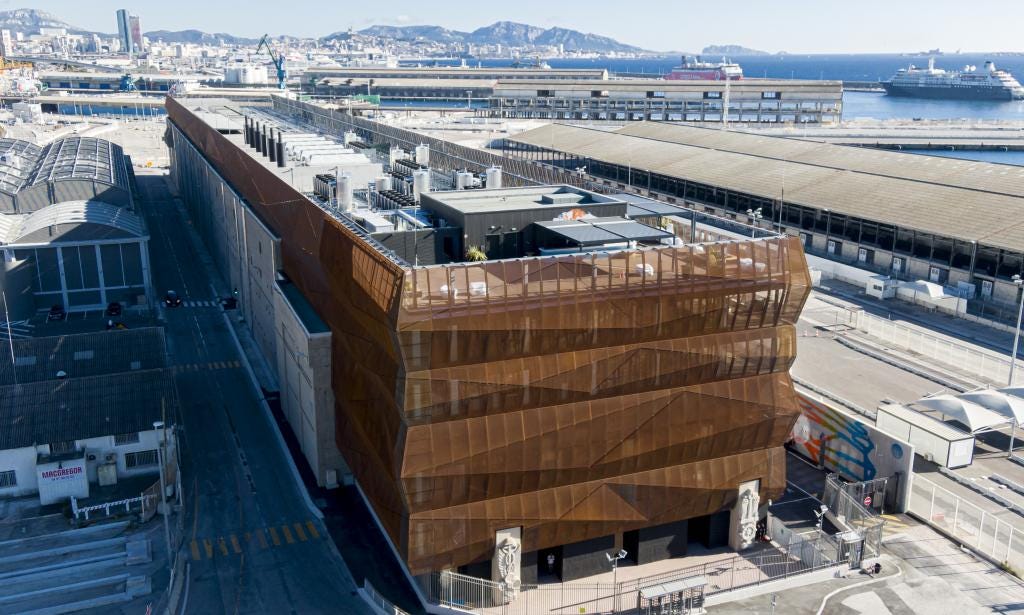
MRS3 has not been universally welcomed. In their book Les Assoiffeurs (The Thirsty Ones), Fabien Benoit and Nicolas Celnik document local and environmental opposition to water-hungry projects across several sectors, data centres among them. In the case of MRS3, they recounted objections to use of scarce drinking water for cooling, as well as concerns about marine biodiversity from discharging warmed water into the sea.
Digital Realty’s latest data centre near Marseille, MRS6, has also drawn sharp opposition, but received its building permit earlier this year. At an estimated cost of €700 million, MRS6 is to be built on the site of a former Decathlon logistics warehouse at Bouc-Bel-Air, about 20 km north of Marseille. At roughly 20,000 m² of server space, it is significantly larger than the firm’s sites in Marseille.
A dedicated opposition website, nondatacenterboucbelair.fr, sets out the range of objections to MRS6: fire risk, water consumption, and visual and environmental impact.
Campaigners, including France Nature Environnement, argue the centre would draw around 80 MW, which they compare to the electricity consumption of a town of 117,000 people, and point to the strain of concentrating so much demand in a region that already hosts five Digital Realty centres.
Digital Realty, for its part, maintains that its centres neither pollute nor generate noise, that the MRS6 site sits within an existing activity zone, and that the facility is essential to French digital sovereignty.
The state’s legal levers
France has tools to push priority projects through the permitting process. At local level, a projet d’intérêt général (PIG, declaration of general public interest) can shift planning decisions from the commune to the state.
For projects deemed strategic, a stronger mechanism exists. The loi Industrie Verte of October 2023 created the status of projet d’intérêt national majeur (PINM, major national interest project).
A 2025 simplification law extended this status to data centres. Once a project is designated by government decree, planning permits are issued at prefect level, urban-planning documents can be brought into line on an accelerated timetable, electricity connection is prioritised, and the decree can grant derogations, including from rules protecting endangered species.
PINM projects remain subject to public consultation and can be challenged in court. So far, those challenges have failed.
The Conseil constitutionnel upheld a species-derogation provision in March 2025, and the Conseil d’État has since rejected appeals against PINM decrees, in cases concerning a lithium project and a plastics-recycling plant. The courts have made clear they apply only limited scrutiny to the government’s reasons for granting the status.
Stepping up the roll-out
The data centre pipeline is now substantial. Campus IA is a 1.4 GW data centre campus planned for Fouju, a village of around 600 people about 45 km south-east of Paris. It is backed by the Emirati fund MGX, Nvidia, Mistral AI and the French public investment bank Bpifrance. The project was first announced at the May 2025 Choose France summit for foreign investment into France.
Campus IA as planned would cover roughly 73 hectares of built area across ten to twelve buildings. If completed, it would be the largest AI campus in Europe. Objections centre on the loss of agricultural land and the scale of electricity demand: at full power, 1.4 GW is comparable to the output of a nuclear reactor. The project has been through a national public-debate process and is now advancing.
The largest data centre investment for France came at the 2026 Choose France summit, held at Versailles last week. Japan’s SoftBank announced plans to invest up to €75 billion to develop 5 GW of AI data centre capacity in the country. The initial commitment is €45 billion for 3.1 GW in the northern Hauts-de-France region by 2031, across three sites: Dunkirk, Bosquel and Bouchain. The further €30 billion is conditional on the first phase succeeding.
The trajectory for data centre construction in France is consistent and growing.
France is offering foreign capital its decarbonised grid, land (industrial and agricultural alike) and a legal framework built to clear obstacles fast. The tension between local objections, environmental concerns and national priorities has not been resolved. From an investment and construction point of view, the clear political will and ‘major national interest’ permitting is underpinning growth.