


Changing the design of a centuries-old cathedral, or a new housing development in a historic streetscape. Everyone you ask has an opinion, often a strong one. Especially if they’re torn between familiarity and the need for change. Wanting to retain a city they love, but impacted by a housing shortage.
France has a system for managing the design tensions and development trade-offs. A corps of heritage architects employed by the Ministry of Culture is deployed to every département in France.
These architectes des bâtiments de France (ABF) have a dual role:
custodians of State buildings, and
advisors to permitting authorities in the framework of urban planning law.
I’ll outline the planning advisory role below. In short, ABF give mandatory or advisory rulings on whether a proposed development fits in a protected historic setting.
Some responders to a French Senate enquiry in 2024, on the role of ABF, complained about subjective decisions.
Two cathedral projects illustrate how one corps of architectes des bâtiments de France can deliver very different styles.
French cathedrals are owned by the state, and works to renovate or alter them are overseen by the ABF. After a catastrophic fire in one cathedral, the architects returned the structure to its pre-fire state. The few differences include new liturgical furniture and a much brighter interior, thanks to walls cleaned for the first time in centuries.
The project was Notre Dame.
The other project was 300km south west of Paris in the Loire Valley, the Cathedral of St Maurice in Angers. In the 19th century a gallery on the front façade was removed, exposing the polychrome-painted sculptures around the main door to the sun.
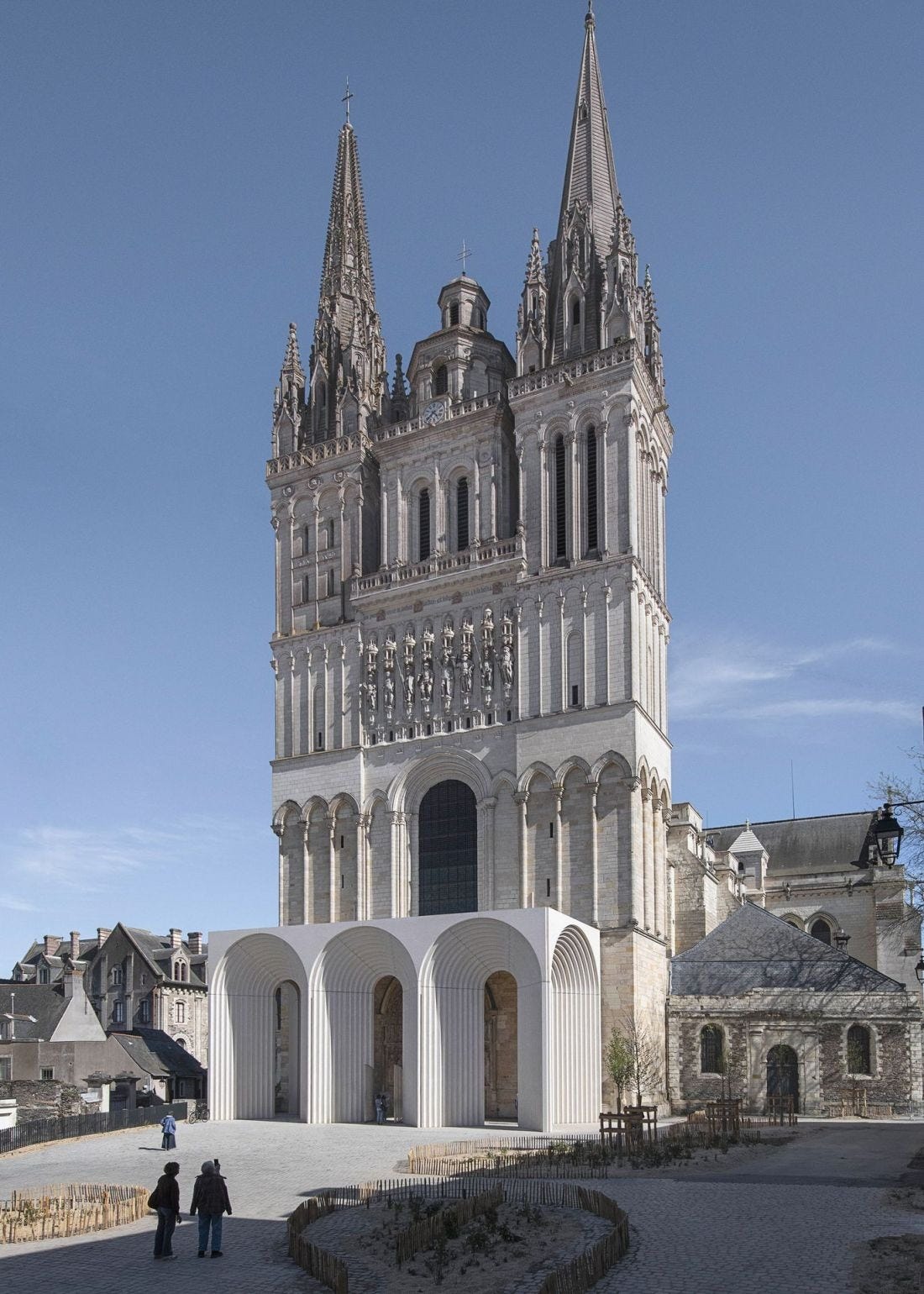
The state architects wanted to replace the gallery to protect the paintwork from sunlight. The problem: there was very little documentation of the original design. So the ABF took a very different approach - modern simplicity, to a design by Kengo Kuma. A classical series of arches, no ornament. Concrete, though with carefully chosen local sand and aggregate.
But that’s just two projects.
The bigger picture is that France has managed to preserve the integrity of its countless beautiful historic villages, towns and city districts. And that’s thanks in large part to the powers and role of the architectes des bâtiments de France.
What are the rules for development in heritage-protected areas? What is the role of ABF, and how does an architect or developer navigate the rules?
Building in heritage-protected areas
Heritage protection applies when two conditions are met: 1) a project needs a planning authorisation and 2) the site sits inside a protected perimeter. An authorisation can be a building permit, a demolition permit or a déclaration préalable (a prior declaration, a lighter consent for minor works such as a new window or façade change).
The main protected perimeters are:
The surroundings of a listed monument: a default 500-metre radius, or a tailored perimeter set out in the local urban plan. Within a default 500m radius, ABF control is binding if the project is visible from the monument, or if both the project and the monument are simultaneously visible from a public vantage point. This is referred to as covisibility.
A site patrimonial remarquable (SPR, remarkable heritage site): a whole town, village or a district of recognised heritage value.
Classified or listed sites and other protected landscapes.
In these zones, the permitting authority must consult the ABF in relation to a permit application.
The role: what the ABF decides
The ABF sits within the unité départementale de l’architecture et du patrimoine (departmental architecture and heritage unit, UDAP), under the Ministry of Culture. In protected zones it issues one of two opinions:
Avis conforme (binding opinion): the mayor cannot grant a permit against it. A negative opinion is, in effect, a veto. This covers most works that change a building’s external appearance in a remarkable heritage site, or within a protected buildings’ surroundings.
Avis simple (advisory opinion): the authority may depart from it, but risks litigation at a later date. It is reserved for less sensitive cases, such as mobile-phone antennas, works on unfit or dangerous housing, and projects in a monument’s surroundings where there is no covisibility.
What the ABF assesses is broad: massing and height, materials and colours, façade rhythm and detailing, and impact on views to and from the monument. The governing test is insertion harmonieuse (harmonious integration) into the surroundings. That phrase is where much of the perceived subjectivity lies.
The ABF also shapes the rules upstream, co-authoring the local heritage plan and helping to draw the perimeters themselves.
Navigating the process
For an architect or developer, the following area a few practical points to keep in mind:
Check the heritage protection boundary. Before buying land or starting the design process, confirm whether the site is within 500 metres of a protected building, a remarkable heritage site, or a classified site. These perimeters are publicly mapped.
Engage the ABF early. They encourage consultation early in the design process. The heritage architects can give observations on a preliminary design, before submitting a building permit application. This ensures the plans already take likely heritage requirements into account.
Budget for ABF requirements. The formal opinion usually comes with conditions on materials and detailing (timber windows rather than PVC, use of local stone). These are decided case by case, so add a budget contingency. Early consultation narrows the uncertainty.
Build in extra time. An ABF referral extends the permitting process by about a month. The timeline gets longer if the design has to be reworked during the permitting process. A change in external appearance means the heritage architect is consulted again.
Know the appeal route. The options and deadlines will be set out in the local authority decision. Appeals can be brought to the regional prefect (the state’s representative in the region), or the administrative court.
In response to the housing crisis, a government bill seeks to dilute the veto power of the architectes des bâtiments de France
The bill (projet de loi Relance Logement) includes an ‘operation of local interest’ mechanism for areas with a housing shortage. Housing projects with this label would get derogations from the local urban plan, and ABF opinions would be advisory, not vetos.
In a Le Figaro op-ed at the beginning of July, a group of academics, historians and public figures complained that the Relance Logement law would lead to a soul-less France full of concrete. Referring to a 2018 “Elan” law that weakened ABF powers, they complained that the Relance Logement law would be its culmination.
Energy efficiency and renewable energy roll-out are high priorities in French construction. They’re also central to the tension between development and heritage protection. The 2024 Senate enquiry on the ABF role heard complaints about:
blocked solar PV installation on houses and apartments in heritage-protected areas, and
deadlock around external insulation and façade alterations.
The Senate report documents numerous cases where homeowners within protected areas sought rooftop PV installations to meet rising energy costs and energy performance obligations, only to face repeated refusals or highly restrictive conditions from ABF.
Owners or social landlords have tried to apply off‑the‑shelf exterior insulation systems to old‑style façades. But ABF have refused these solutions on the basis that they both disfigure the historic appearance (by thickening and flattening façades and hiding traditional materials).
The technical risks for old, moisture‑sensitive walls are also taken into account. ABF instead steer projects towards less visible or more tailored forms of energy renovation, but these may be more expensive and reduce internal space.
It’s clear that there’s a tension between France’s ambitious climate goals and protecting its outstanding architectural heritage. Differing approaches to renovating a cathedral, and the proposed Relance Logement law making its way through Parliament, show maintaining a workable balance is a subject of ongoing debate.
PS: A YouTube video on the Angers cathedral project.