


Walk through Clichy-Batignolles in north-west Paris and you’ll find a 10-hectare park surrounded by schools, a theatre, a hotel, social housing, market-rate apartments, and the new Paris courthouse. Twenty years ago this was a freight rail yard.
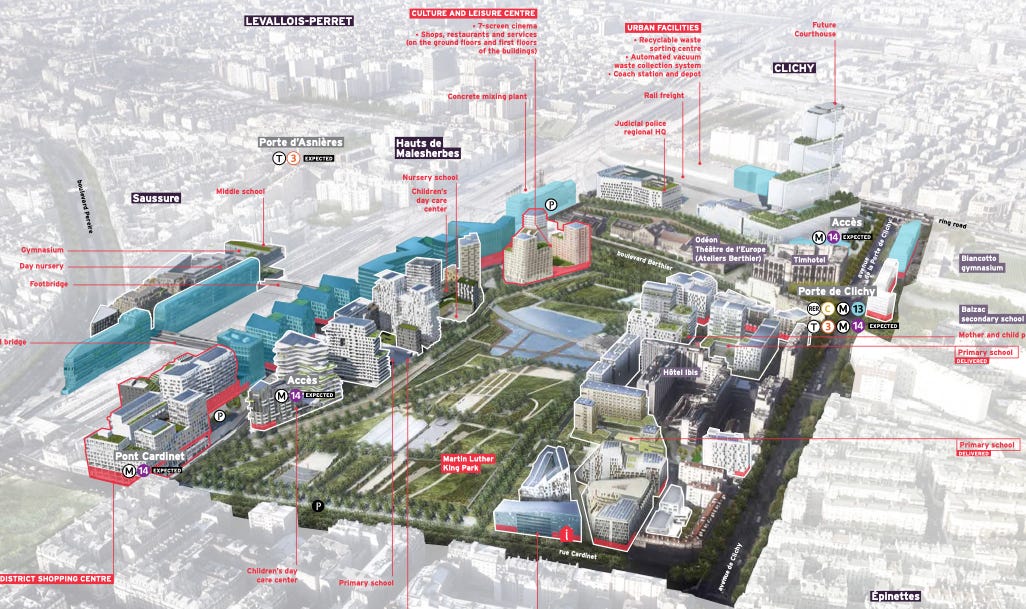
Urban transformations like Clichy-Batignolles are delivered by creating Zone d’Aménagement Concerté (ZAC), a Coordinated Development Zone. The ZAC is a mechanism in French planning law, the Code de l’urbanisme.
How the mechanism actually works
A ZAC is created by a municipal authority, sometimes the state. It maps a defined perimeter that the authority wants to develop or redevelop. Early stages involve a study and public consultation, an environmental assessment, and setting out the project’s objectives and programme.
The public authority appoints an aménageur, or master developer, to assemble land, deliver primary infrastructure, and sell serviced plots. The master developer role can be filled by the municipal authority itself, by a publicly-owned or joint public-private company, or by a private operator under a development concession.
Every ZAC is governed by a multi-year development scheme budget, the bilan d’aménagement. It’s the master developer’s budget, balancing revenue and expenditure across the life of the operation. Accountability to the municipality is based on annual reporting.
Land assembly
Crucially, the aménageur is equipped with real powers to assemble land. Inside a ZAC perimeter, it can use préemption to acquire sites as they come up for sale. Alternatively, compulsory purchase can be pursued on the basis of a declaration of public utility.
This is how whole neighbourhoods like Clichy-Batignolles go from idea to completion in 15-20 years. The aménageur is not negotiating with hundreds of landowners one by one over decades.
The financial logic
Once land is assembled, the aménageur carries out the heavy lifting: demolition, depollution, archaeological investigation, and the primary infrastructure for serviced building plots. It then sells those plots to private developers, who build housing, offices, retail, or whatever the programme calls for.
The master developer’s revenue comes mainly from land sales and from public works contributions from private developers. Expenditure covers land acquisition, works, studies, and overheads.
What this structure does, in commercial terms, is capture the uplift between pre-development land value and serviced land value, and use it to pre-pay the public realm, the social housing, and the infrastructure. The private developer then builds on a serviced plot at full market rate. The affordability and the public goods are not squeezed out of the developer’s margin; they are funded upstream by the value the assembly process itself has created.
The Anglo contrast
In the Anglosphere, it’s usually developers who take the lead in land assembly and real estate development, capturing most of the value along the way. They also bear risks linked to archaeological finds and contamination. In the French model, the public authority captures the land value uplift. And by the time a private developer is bidding on a plot inside a ZAC, the riskiest below-ground work is done.
The private developer’s role inside a ZAC is not diminished, it’s just different. They’re not the patient land assembler taking decade-long bets on consents and contamination. The private developer skills that matter in a ZAC are not land-banking and planning risk management, they’re design quality, delivery credibility, and the ability to work inside a public-led framework.
Acting in concert
In a Zone d’Aménagement Concerté, the concertation part is key. It is a specific public consultation duty under French planning law, which starts before a coordinated development zone is established, and continues throughout the operation.
In practice, it means structured engagement with residents, business associations, and other affected parties, alongside cooperation between the municipality and the private sector.
ZACs in Paris and Lyon
Clichy-Batignolles is one example of a coordinated development zone. For a larger-scale example, check out Lyon Confluence - the regeneration of a former industrial and transport peninsula at the meeting of the Rhône and Saône rivers.
Paris-Saclay, the project to build out a science and technology cluster on the plateau south-west of Paris, combines several ZACs. The mechanism scales from neighbourhood redevelopment to strategic infrastructure projects.
The park, the courthouse, the schools, and the apartments at Clichy-Batignolles were not the product of a developer making the right bet on a freight yard. They were the product of a planning mechanism that lets the city take the lead as land assembler, primary investor, and orchestrator. The city carries out enabling works, then sells serviced sites to private developers to build on.
If you’re following French construction and urban development, the ZAC mechanism is the key to understanding how development and regeneration is planned and delivered. It shapes who assembles the land, who carries the early risk, and how affordability is funded through value capture.
Once you understand ZACs, much of what looks unique about the French development market starts to make sense.
Isn't this a variant of what Letwin proposed in the UK context?
Superb - glad this was explained as it’s a superb model which can be adapted