


Stone reads to the public, and to many in the building industry, as a heritage or luxury product. But the contemporary revival of load-bearing stone walls, not least in France, is a sound low-carbon move.
A series of housing projects in Paris have already put a dent in the “too-expensive” perception. Like the 15 housing units on Rue Pradier in Paris by MAO Architectes, or the 17 social housing units on Rue Oberkampf by Barrault-Pressacco architects. Both were delivered as mainstream housing rather than high-end commissions.
But what if the advantage of load-bearing stone walls was less in the monetary price and more in the carbon saving?
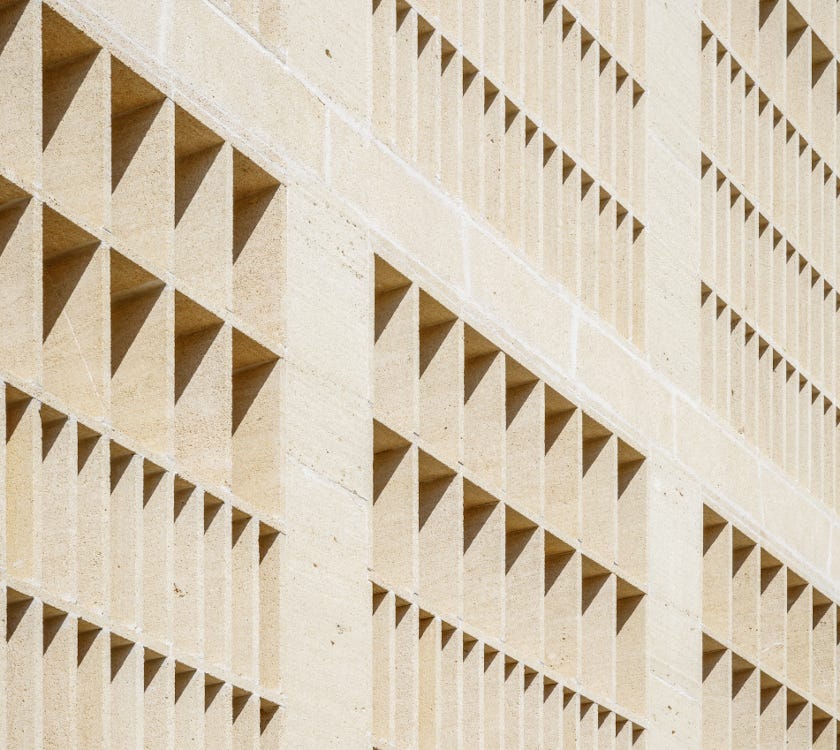
What Counts as Massive Stone
A French architect colleague introduced me to the work of Gilles Perraudin over ten years ago. I was amazed at the beauty and simplicity of his buildings built purely out of massive stone blocks. I did wonder at the lack of insulation, but we’ll get to that in a later article.
The wave of 10- to 130-unit Paris-region schemes of recent years (Félix-Faure, Jean-Bart, Cévennes, Versailles rue des Chantiers, Triangle École-Évangile, Rosny-sous-Bois) consists overwhelmingly of composite self-supporting stone facades tied to a concrete or steel frame, rather than pure load-bearing masonry.
This article is about masonry construction where stone is stacked so each course bears on the one below. This can be the fully load-bearing approach associated with Perraudin, or the self-supporting stone facades tied to a supporting frame. Stone cladding as a rainscreen is not in this scope.
Where Stone Wins: Carbon
The case for load-bearing stone is made in a 2023 paper by de Toldi and Pestre. The paper was based on a study of French environmental product declarations (EPDs) with reference to the dynamic life cycle analysis required by the RE2020 building-carbon regulation. De Toldi and Pestre’s model found that cut-stone load-bearing walls generate 18.08kg CO2e/m², roughly 1.43 times better than cross-laminated timber (CLT) and 2.73 times better than slag concrete. These figures assume the industry-average wall thicknesses of 13, 20 and 24 cm for CLT, concrete and stone respectively.
Stone’s carbon competitor is timber. How far stone beats CLT depends on the method used to count the carbon a tree stores as it grows.
Under the RE2020 regulatory convention, which credits that carbon up front, timber is counted as carbon-negative and beats stone.
Under Levasseur’s dynamic method, which instead credits stored carbon gradually as the replacement tree regrows, stone comes out roughly 1.43 and 3.62 times better than timber, depending on the tree-growth model assumed and the building lifespan used.
Whichever method is used, stone’s own figure barely moves, while timber’s swings from best to worst.
Transport makes or breaks the carbon advantage of stone. The de Toldi and Pestre paper assumes an average quarry-to-site distance of 60 km nationally. At that distance, haulage is only about 12 per cent of a stone wall’s embodied carbon; stretch that to around 580 km and the wall’s total embodied impact doubles, with transport rising to 56 per cent of it. The low-carbon case therefore depends on local sourcing.
The Processing Advantage
The thickness of stone is a plus point. Thin decorative stone has a higher carbon footprint, with more processing per unit volume. A thicker slab will spread a given level of processing across a greater volume. An earlier ETH Zurich study (Ioannidou et al., 2014) found thicker massive assemblies to have roughly a third of the carbon footprint per square metre of thin stone products.
Another point in its favour is the fact that stone is quarried, not manufactured. It’s mechanically shaped rather than chemically synthesised. De Toldi and Pestre put the carbon impact of cut stone about 2.7 times below slag concrete, at industry-standard wall thicknesses. A stone-sector presentation drawing on INIES data makes the gap look starker still, charting a massive stone wall at roughly half the embodied carbon of a reinforced-concrete wall, around 20 against 41 kg CO2e/m², though there a 40cm stone wall is set against a 20cm concrete wall, so treat it as indicative rather than a like-for-like contrast.
The Premium, Examined
Fully load-bearing stone buildings are the exception. The self-supporting facade, by contrast, is a genuine mainstream option. The built pipeline of recent years consists overwhelmingly of self-supporting or hybrid facades on concrete or steel frames. That distinction matters for cost, because that facade choice is also the cheaper to build and, as we will see, the easier one to insure.
The sharper premium applies to the fully load-bearing approach. Supply is not the constraint: one regional estimate suggests Paris Basin quarries alone could already furnish enough stone each year for 6,000 to 9,000 dwellings in self-supporting facades, a point the supply-base article takes up.
As for the cost premium itself, a rare publicly cited figure comes from the president of the SNROC, the building-stone trade body, who puts the extra cost of a stone building over an equivalent concrete one at 6 to 10 per cent. Read it as a whole-building figure rather than the stone element alone.
The Insurance Question
Where does that premium come from? A large part of it is the insurance regime that applies to buildings, and their designers and builders, rather than the cost at the quarry gate or the shortage of specialist masons.
To provide the ten-year liability cover that’s required for French building, insurers typically only provide standard cover for standard building methods (techniques courantes). A fully load-bearing massive-stone system, with large blocks, thin joints and no concrete ring-beam, largely falls outside these. That places it in non-standard territory (technique non courante).
Non-standard building techniques must be declared to the insurer in advance, triggering a bespoke risk assessment and usually a higher premium loading.
There are two main ways to reach standard rates. A favourable ATEx, an assessment by the French building science centre, the CSTB, can let the technique be treated as standard. Alternatively, a project-specific quality plan overseen by the Centre Technique de Matériaux Naturels de Construction can satisfy the insurer without the technique itself being reclassified. The latter is the path taken at Barrault-Pressacco’s Oberkampf.
It is worth adding that these routes are not free. An ATEx carries CSTB assessment and testing costs, and a quality plan carries its own testing and consultancy fees. So while they keep the insurance premium at standard rates, they move part of the cost upstream rather than removing it. That’s one reason why a stone project can still carry a cost premium even when it is insured on standard terms.