


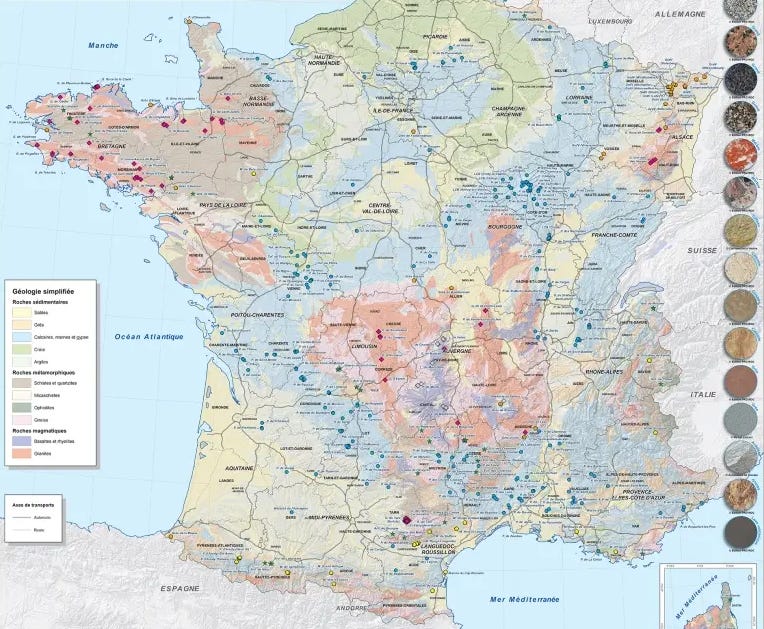
The map below, published by the French Bureau of Geological and Mining Research, BRGM, shows the availability of stone and active quarries in France.
The National Picture
The Massif Central is immediately identifiable in the centre of France, west of Lyon, in the Auvergne. The central red-shaded area indicates deposits of granite.
Brittany also stands out, on the Armorican massif that extends into the Loire and Normandy regions. The numerous red points on the map indicate granite quarries.
The limestone that we associate with French buildings comes from the areas marked in blue.
As well as the Paris basin, limestone extends from the Lorraine region in the north-east, extending in an arc south-westwards around the Massif Central, through Poitou-Charentes, around to the Provence-Alpes-Côtes-d’Azur region in the south-east.
As part of an economic study published in 2024, SNROC, the building-stone trade body, provides a snapshot of the use of stone in French building.
In 2020, the French ornamental and construction stone industry’s revenue was €525.4 million (down 3.9% compared to 2019).
Most of the industry’s output is used for roads and funerary monuments. In 2020, 46% (as a proportion of sector revenue) was used for building. While most of French quarried limestone (85% in 2020) is used for building, the picture is almost the inverse for granite (24% in the same year, again by industry revenue).
The Paris Basin
Before I moved to Paris, one of my first ports of call on my visits here was the Pavillon de l’Arsenal near Bastille. These days I miss their excellent exhibitions on architecture and building, and can’t wait for their reopening after renovations. Back in 2018, the Pavillon held an exhibition on building in stone, framing it as a local low-carbon material capable of responding to the Paris region’s then goal of building 70,000 homes per year up to 2030.
The guide accompanying the exhibition featured nine limestone quarries to the north-east of Paris. How have things changed since 2018?
All nine quarries continue to operate. Ownership has consolidated around the Saint-Maximin basin, mainly under Rocamat/Iribarren and BPE Lecieux. The Violet, Vassens and Noyant quarries remain independent. What’s encouraging for the availability of stone is that the changes in ownership have come alongside fresh investment, such as re-equipment at Clocher in 2019 and a new plant at Noyant in 2024.
The carbon life cycle accounting required in French building since 2020 has only made local stone more compelling. See my previous article on stone’s carbon footprint, and the relevance of distance to site. SNROC’s study cited above quantifies the carbon impact of importing stone from various countries as far afield as China. The study was published in 2024, soon after RE2020 came into force, when carbon was only beginning to weigh decisively on building-material choices.
The Projects
All the projects shown as unbuilt in the Pavillon de l’Arsenal exhibition have now been completed.
Jean-Christophe Quinton - Paris 6e - eight social housing units.
Raphaël Gabrion - Paris 15e - nine social rental housing units.
Eliet et Lehmann - Versailles - sixty homes, a health centre and offices.
TVK - Paris 19e - a mixed-use quarter of housing, residences, hotel and offices.
Vincent Lavergne and Atelier WOA - Rosny-sous-Bois, Greater Paris (east) - 283 homes with shops.
Can It Scale?
A ZAN (zero net land take) law, passed in 2021, now limits urbanisation in France. That is, the extent to which development can take place on natural, agricultural and forest land. At first glance, the law would seem to limit the expansion of stone quarries. But because the landscape can be restored upon quarry closure, their expansion is not counted as urbanisation. Therefore ZAN should not be a barrier to quarry capacity.
The Paris region’s latest urban plan, the SDRIF-E, maintained the goal of 70,000 new homes per year, extending it to 2040. The Pavillon exhibition guide predicted that there was enough quarry capacity in the Paris basin to support stone construction for 6,000 to 9,000 housing units.
The SDRIF-E requires 90% of homes in the Paris region to be built within the already-urbanised area rather than on greenfield land. That’s a rule about where building happens, not a shift away from new construction. Much urban renewal is dense new-build on infill and demolition-and-rebuild plots, precisely the setting of the projects listed above.
Renewal is therefore no barrier to load-bearing stone.
For stone in French building, the binding constraint is skilled labour, not stone.
According to a 2025-2026 survey by France Travail, the French public employment service, stone-working is among the most recruitment-constrained construction trades.
80% of stone-trade recruitments were judged difficult by employers in 2025.
The 2026 survey places “professionals working with stone and related materials” second among all construction trades for recruitment difficulty at 75.8%, behind roofers (79.8%) and ahead of carpenters (75.6%).
PS. Architect Jean-Christophe Quinton, mentioned above, is presenting an exhibition, Pièce et forme, une poétique élémentaire de l’architecture, at the Arc en rêve centre d’architecture in Bordeaux until 25 October 2026.