


Construction is underway in two Paris redevelopment zones. Both are run as a Zone d'Aménagement Concerté (ZAC), a mechanism in French planning law for coordinated urban regeneration.
A ZAC is divided into lots purchased by individual developers. When selling lots, the ZAC’s aménageur can attach environmental and technical requirements that go well beyond national regulations. They can set carbon caps, biosourced-material thresholds or timber-structure requirements.
Because it also chooses who builds through competitive selection, the aménageur can favour operators willing to trial new materials and methods. Some schemes reserve an explicit strand of experimentation on which the developer commits to innovating.
Applied consistently across a whole zone, this turns a ZAC into a testing ground where low-carbon and bio-sourced approaches can be mandated, delivered and compared at scale.
ZAC Chapelle Charbon is transforming a former railway logistics site north-east of central Paris.
Currently on site at Lot C, Heros Architecture and Atelier Villemard Associés are building 78 social and intermediate housing units, shared spaces, 6 artists’ studios and commercial spaces.
Lot C is built using natural, low-carbon materials like solid stone, timber and recycled steel. The rooftops carry solar panels, glass-roofed artists' studios and thick green roofs that accommodate wildlife and soak up rainwater.
Paris et Métropole Aménagement is carrying out the aménageur role at Chapelle Charbon. Find out more about this urban regeneration on their website (including a January 2026 update with maps, timeline and key facts here).
Lot F at Chapelle Charbon, designed by Nicolas Lombardi Architecture, will deliver 41 apartments alongside ground-floor commercial and activity spaces.
The project utilises the Bail Réel Solidaire, a French community land trust mechanism. It provides permanent housing affordability by separating land ownership from building rights.
Construction at Lot F started last November. The structure is a mix of concrete and timber, with bio-sourced insulation. Check out the developer’s Instagram post below to see a façade mock-up on site.
On the Seine’s Left Bank, ZAC Saint-Vincent-de-Paul is regenerating the site of an old hospital near Montparnasse, south of the Jardin du Luxembourg.
Paris et Métropole aménagement is also the aménageur here. Their Instagram post below shows construction progress on the Chaufferie, Petit and Pinard lots.
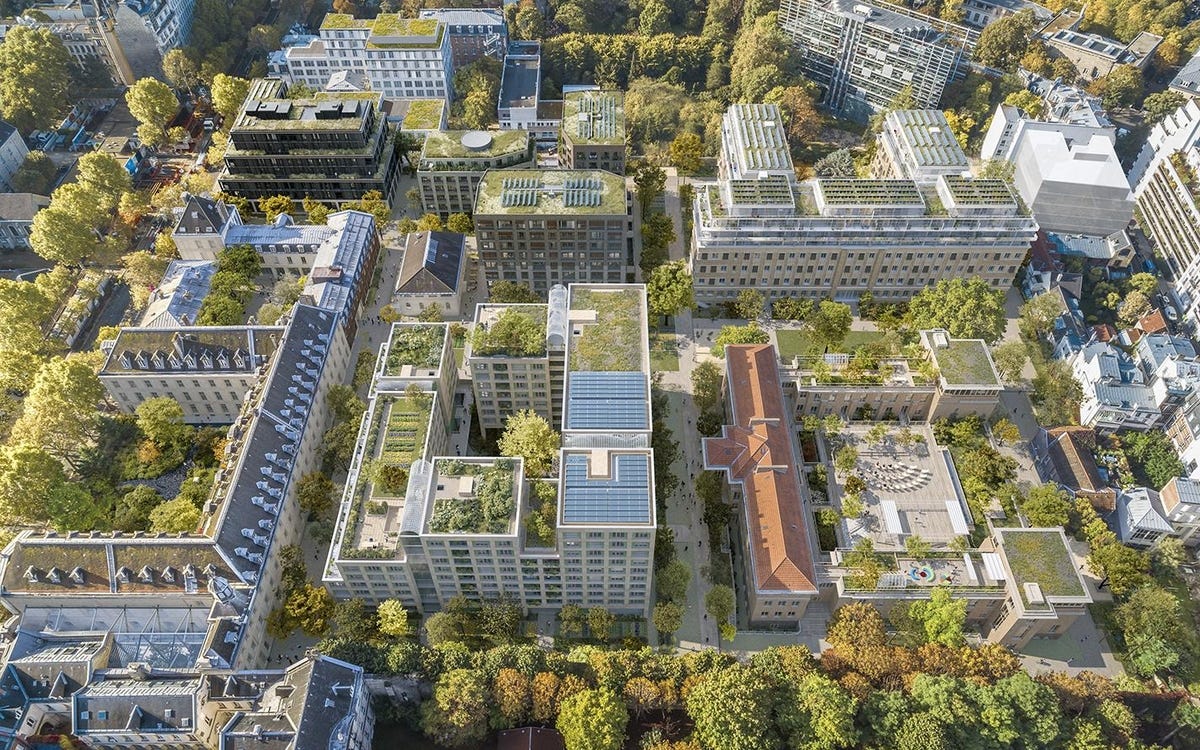
Chaufferie contains social and intermediate housing, shared and commercial spaces. Petit will also provide social and intermediate housing, while Pinard will contain a school, creche, gym and shared spaces.
Across these zones the same logic is visible on site. A single aménageur sets the material and carbon terms lot by lot. Low-carbon requirements are written into the sale conditions, rather than left to each developer.
Comparing how architects and developers respond to these demands, within the same ZAC, is one of the things that makes French urban regeneration worth watching.