


A few months ago I spoke with an American in the building industry who had just travelled through France: first stop Paris, then south to Provence, exploring its historic towns and vineyards.
His question was simple. Where is all the construction happening?
In the capital and across the length of the country, he had passed very few building sites, and almost no new-build.
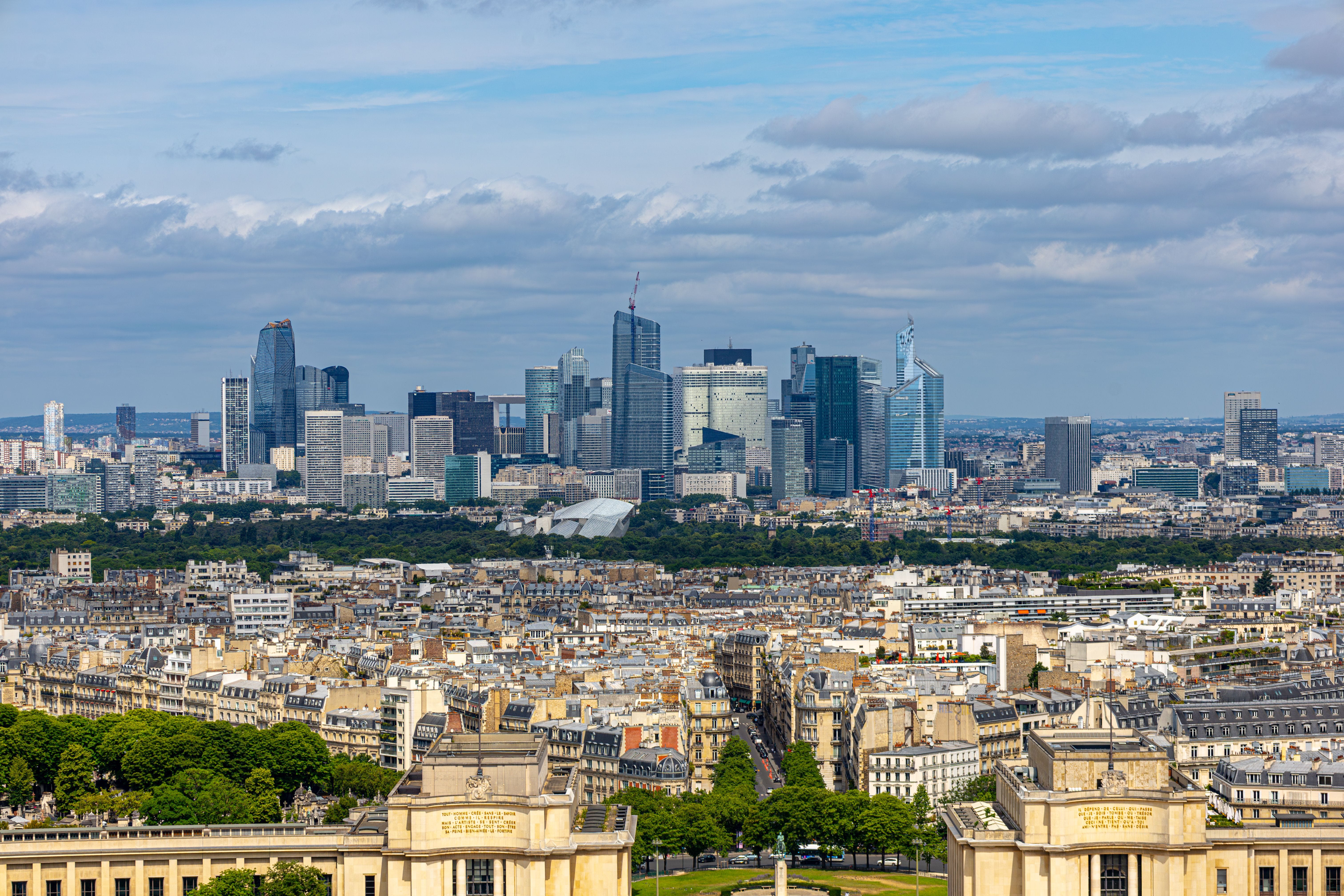
éfense.In a recent article I wrote that France’s construction industry delivers more than three times the economic value of France’s celebrated aerospace industry. So how can an industry that large be hard to see?
A few factors explain the contradiction between French construction’s economic value and its visibility.
Timing: we are in a historic slump
New construction has fallen sharply for three years, on both the residential and the commercial side.
Housing has taken the heaviest hit:
Housing starts dropped to around 263,000 units in 2024, about a third below the 2019 pre-pandemic level.
Single-family detached houses, the most visible category of all, fell about 29% to roughly 68,000 starts, the lowest in decades.
Developers’ new-build home sales collapsed to about 59,000 units, close to half the 2022 figure.
Commercial and industrial building has followed the same curve:
Non-residential floor space started fell about 11% in 2024, a second straight annual decline after a drop of roughly 15% in 2023.
Offices and retail led the fall. New retail schemes built from scratch have all but vanished, and office demand is still adjusting to remote working and surplus space.
The construction sector shed roughly 35,000 jobs between 2022 and 2024, with a further 20,000 to 30,000 going in 2025.
The apparent lack of building is partly due to a cyclical trough driven by high interest rates, the end of subsidised buyer schemes, and tighter lending. The cranes are fewer than usual. But a slump in new-build doesn’t mean a slump in construction overall.
Behind the facades, the less visible sites
Most French building activity is renovation and maintenance rather than new construction: refurbishment and the energy retrofit of the existing building stock.
New-build fell to 43% of building activity in 2024, its lowest share since the crisis of the late 1990s. In a normal year renovation and maintenance represent the larger share of construction, closer to 53%; the slump has widened a gap that was already there.
Maintenance and improvement work reached roughly €118 billion in 2024, of which about €31 billion was energy renovation.
The state retrofit scheme MaPrimeRénov’ funded around 340,800 renovations in 2024 (€3.29 billion in aid), and more than 2.4 million dwellings since 2020.
This is insulation, heat pumps, new windows, kitchens and bathrooms, and the refitting of shop and office interiors. It rarely needs a crane, a hoarding or scaffolding. Walk past a centuries-old facade and the activity, and the value, may be entirely inside.
Commercial property is making the same pivot. After a decade of heavy output that delivered more than 7.5 million m² of new offices in Île-de-France, the new-build pipeline has fallen back to 2016 levels. Developers are pausing schemes and turning to refurbishment.
At La Défense, vacancy has reached around 15%, among the highest on record. Only a couple of new schemes broke ground in 2025, while roughly 250,000 m² in obsolete towers is being restructured for energy and layout upgrades.
Concentration: building where tourists are scarce
What new construction there is clusters in a few regions, and within them on urban edges and former industrial land.
Logistics is the clearest case. France’s stock of large warehouses (those of 10,000 m² and above) has reached around 90 million m². It’s concentrated along the Lille–Paris–Lyon–Marseille corridor and across the north and east, where the four leading regions hold close to 60% of it.
Reindustrialisation, a national priority, drove about 2.74 million m² of construction in 2024, concentrated in the north and the Alpine east: the Dunkirk “battery valley” and the Grenoble–Crolles semiconductor cluster.
Public and collective buildings such as schools, hospitals and sports halls are one of the few growing categories. In Île-de-France they made up 30.5% of permitted new-build in 2024.
These logistics and industrial buildings are located on the edges of urban zones. Public facilities are dispersed across suburbia. They’re rarely on the typical tourist path.
The biggest project is mostly underground
The Grand Paris Express, Europe’s largest infrastructure project, is invisible by design. The €36 billion project in Greater Paris, with 200 km of new metro and 68 stations, is still on site. Most of it is underground: tunnel boring, station boxes, equipment galleries, behind hoardings in suburbs a central-Paris visitor never reaches (Saint-Denis, Champigny, Saclay).
The same holds for public works generally. Roads, rail, water and energy networks are linear, often buried and widely dispersed, not concentrated photogenic sites.
Data centres, the highest-profile commercial build-out in France today, mostly follow that pattern above ground: low, windowless sheds in suburban industrial parks such as Essonne and Marne-la-Vallée, with landscaping designed to keep them discreet.
A conspicuous exception can be found in Marseille, a data centre hub due to the submarine cables landing there. One of the city’s most striking buildings is Digital Realty’s MRS3, a data centre that occupies a former WWII German submarine bunker on the harbour front.
Historic centres, frozen by heritage law
A visitor’s mental map of France is made up primarily of the historic areas where new construction is most tightly constrained. Whole districts in Paris are designated Sites Patrimoniaux Remarquables (Remarkable Heritage Sites). Any construction, demolition or even exterior change within sight of a listed monument requires sign-off from the Architecte des Bâtiments de France (state heritage architect).
In the Instagrammable centres of Paris, Avignon, Aix and Bordeaux, large visible new-build is rare. What construction does occur is small and easy to miss: roof-raising (surélévation), which Paris actively encourages to add homes without taking new land, and reconstruction behind retained facades.
Rural France: two speeds
Outside the metros, the gap between statistics and visible activity widens, and “rural France” is really two different places. New building concentrates on the coasts and around a few dynamic southern and western cities: France’s coasts alone took 1.6 million new homes between 1990 and 2020, about 17% of the national total, built at close to three times the average density.
The interior is the reverse. Across the low-density “empty diagonal” that runs from the Ardennes to the south-west, and through much of the vineyard-and-village country a visitor actually drives through, most of the 35,000-odd communes see only a trickle: a single house or a barn conversion here and there, never a concentrated site.
Policy reinforces this. France’s Zéro Artificialisation Nette (ZAN, “zero net land take”) aims to steer development onto already-urbanised land.
This reduces the edge-of-town building on greenfield sites that a traveller notices from the road. It’s worth noting that the ZAN framework is politically contested: the TRACE bill moving through Parliament would heavily loosen the rigid interim 2031 trajectory and exempt vital social housing, while keeping the 2050 goal.
The direction of travel still favours infill over sprawl. And much rural construction spending is in fact renovation: energy retrofits, second homes, heritage repair.
So he was not wrong
The visitor was reading a real signal. France is building less new housing than at almost any point this century. The country’s construction effort is weighted further to renovation; billions are being invested underground and along transport corridors; and commercial development is focusing on discreet data centres and industrial sites. French construction remains highly active, but it’s not so obvious from a café terrace in the Marais, or the vineyards of a Provençal chateau.