


When we think of net zero, we think of carbon emissions, or carbon dioxide emissions, or greenhouse gas emissions. And the building industry is a large contributor.
According to the Ministry for the Ecologic Transition, in 2022 the French building sector represented 43% of annual energy consumption. It generated 23% of French greenhouse gas (GHG) emissions.
There’s another widespread negative impact of construction that GHG reduction doesn’t address: biodiversity loss.
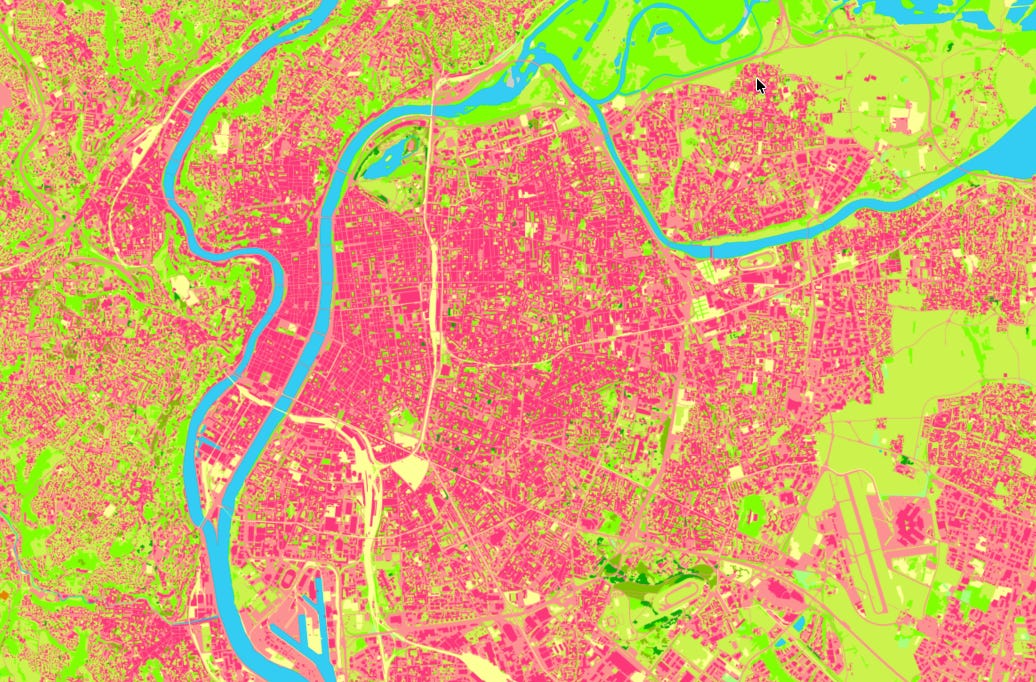
According to the World Wildlife Fund, biodiversity keeps ecosystems stable and resilient. It supports food security, access to clean air and water, and protection from natural disasters.
The construction industry contributes to biodiversity loss through the destruction of habitats and land take (artificialisation des sols). Land take is defined in French law as the durable impairment of a soil’s ecological functions and its agronomic potential.
France’s national biodiversity strategy 2030, published in 2023, lists five pressures on biodiversity. Construction contributes to three of them: destruction and impairment of natural environments, climate change, and pollution.
As for action, reducing land take is a key measure. The strategy commits to capping total land consumption at 120,000 hectares over the 2021–2031 decade. That’s roughly one tenth of the Île-de-France region around Paris. This is part of the goal to cut in half the consumption of natural, agricultural, and forest land by 2030.
How does the French urban planning system implement net zero for biodiversity by 2050? We have to go back to 2019, when France held a Citizen Convention for the Climate. 150 citizens convened over a year, debating and then agreeing on 149 recommendations to protect the climate. One of their objectives was:
“Tackling land take and urban sprawl by making life in towns and villages attractive.”
The vast majority of recommendations made their way into a Climate and Resilience law passed in 2021. The law commits France to the absence of any net land take by 2050, a goal known as Zéro artificialisation nette (zero net land take). The 2050 target is supported by intermediate targets for each decade from 2021.
What does it mean?
The ZAN (zero net land take) law limits the extent to which development can take place on natural, agricultural and forest land (ENAF - espaces naturels, agricoles ou forestiers)
The figure to count is the amount of land urbanised in a given local authority area.
As a first step, the law took the national amount urbanised from 2011 to 2021 and legislated that only 50% of that amount could be urbanised from 2021 to 2031.
The amount would reduce further in the following two decades. From 2031 the measure changes from land consumption to net land take, so the 2050 target is a balance between land urbanised and land restored, not an end to building on undeveloped land.
For Bordeaux Métropole, that means a 520-hectare land take allowance to 2031. By 2024, 200 hectares of that had already been consumed.
The Métropole de Lyon had zoned 1,030 hectares as urbanisable (available for development) as of 2023. ZAN would require them to take 450 hectares of that out of the development pipeline by 2040.
How to implement it
When it comes to controlling the rate of urbanisation, France has the advantage of not being a federal state. Unlike the US or Germany, the central government and parliament in Paris can legislate on regional and local land use.
The 2021 law (as updated since) provides for ZAN requirements to be included in regional planning documents, and for local urban plans to be compatible with them. It’s a cascading series of plans that ensures national building limits are reflected in local permitting decisions.
The progressive reduction in net land take between now and 2050 must be reflected in local development plans. This limits the issuing of building permits on land not yet urbanised. It also encourages redevelopment of former industrial sites and wastelands.
This fundamental change in urban planning impacts all sectors of the economy, from the major cities to the smallest municipalities. Local authorities and public representatives at every level are impacted, having to balance local development expectations with biodiversity constraints.
To increase understanding and measure progress, a national observatory provides data and resources on reducing the consumption of natural, agricultural and forest land.
The limits on urbanising land means local authorities have to consider carefully what gets built on available land, and will guard their allowance. So what happens if the state or a national body wants to build a facility in a particular commune? What happens to the mayor’s land-take calculation if the SNCF (the national rail company) wants to develop a rail line, or a government-support foreign investor wants to build a data centre, in their commune?
The ZAN law sets aside a national allowance of 12,500 hectares over the 2021–2031 decade for projects with national importance. This allows strategic projects to go ahead while avoiding conflict over scarce land take allowances.
Why France can implement ZAN (and others can’t, or less so)
It helps that France is a unitary, not a federal, state. That’s what allows law-makers in Paris to influence land-use in local communes down to the hectare.
Germany has a national target limiting land take: under 30 hectares per day for new settlement and transport by 2030, and net zero by 2050. However, it is non-binding. In Germany, land-use planning is primarily a regional and municipal matter. Compared to France, this makes it harder to implement a mechanism to reduce land take uniformly across Germany.
Likewise the US has no federal land-use competence; planning and zoning are constitutionally reserved to states.
In England, there would have to be a stronger legislative link between national policy and local plan-making, which the government’s own 2025–26 reform trajectory is not pursuing. If anything, English policy is moving toward loosening land-supply constraints (Green Belt release) rather than tightening them.
Switzerland has the closest equivalent to ZAN. Under its revised Spatial Planning Act (2023) cantons face a firm “stabilisation target”: outside designated building zones, the number of buildings and the amount of built-up land can grow by no more than 2% above the 29 September 2023 baseline. If a canton exceeds this limit, any new construction or land take must be offset one-for-one by demolishing buildings or restoring land elsewhere - a compensation system similar in function to ZAN’s land restoration offset.
Is it working?
A 2026 report by Cerema found that consumption of previously undeveloped natural, agricultural, and forest land (ENAF) has shown a downward trend at the national level since 2011. It reported that 2024 marked the lowest calculated level of ENAF consumption recorded since 2011, with 15,119 hectares consumed nationwide.
However, the period since the ZAN law has coincided with construction material cost and interest increases, and a property market downturn. Cerema itself attributes the fall to the cyclical decline in housing and commercial construction starts since 2020. Therefore the extent to which ZAN is responsible for lower ENAF consumption is not clear.
The framework is also under sustained legislative pressure. The TRACE bill, adopted by the Senate in March 2025, would abolish the 2031 milestone and push back the deadlines for regional and local plans. It is still awaiting a first reading in the Assemblée nationale.
Rather than see ZAN is a block on development, it’s worth referring back to the intentions of the Citizen Convention on the Climate. Reduced land take was intended to:
Take action for biodiversity, the protection of peri-urban forests, and local agriculture; and
Make city centers more attractive and socially diverse by revitalising businesses and economic activity, while also bringing nature into the urban environment.
PS: if you’d like to view the progression of land take in France over recent decades, check out the aerial photography on the Remonter Le Temps website: https://remonterletemps.ign.fr/comparer/