


Dublin, Amsterdam, Berlin: right across Europe, house building has got more expensive. Not just since the war in Ukraine and the energy shock that followed. Prices were already climbing back in 2019.
You can see the result in our cities. Fewer building sites. Less new housing.
But France looks different. Browse ArchDaily, Dezeen or Instagram and you’ll see a steady delivery of housing: apartments with well-designed shared spaces, considered façades, some clad in the Lutetian limestone that evokes classic Paris.
France has several tools for planning and land assembly that help keep final prices down.
But there’s another part of the picture. A public financial institution with no real equivalent outside France: the Caisse des Dépôts et Consignations (CDC).
Created in 1816, the CDC is unusual in two ways. Firstly, it answers to Parliament rather than to the government, a deliberate design to keep deposited savings beyond the reach of the Treasury.
Secondly, its reach across the French economy is wide: low-cost lending for infrastructure and housing, financing for hospitals, and substantial equity stakes in some of France’s most recognisable companies, among them La Poste, the public investment bank Bpifrance, and the electricity transmission grid RTE.
So what does a 200-year-old savings institution have to do with housing, and with housing quality? The short answer is the cost and the patience of its money.
Cheap, very long finance lowers the cost of building social and intermediate homes. And capital that holds an asset for decades can absorb the higher upfront cost of quality, better materials, lower carbon, longer-lasting buildings, because it is not trying to sell at a profit in a few years.
The numbers
Start with the wider market. In 2025, around 275,000 homes were started across France. That is a generational low: the figure was over 437,000 as recently as 2017. These starts are overwhelmingly private: owner-occupier houses and developer-built apartments, financed by ordinary mortgages and bank credit.
Separately, in 2025 the State authorised and subsidised about 118,000 new social homes. These aren’t construction starts. They are funding agreements, homes that would appear on site a year or two later.
On social housing, the CDC is close to the whole of the debt. The State’s own figures put its loans at roughly 72 per cent of the housing delivery cost, and over 90 per cent of the borrowing for the build. In 2025 it signed a record 41.7 billion euros of new loans, 22.9 billion of it for social housing.
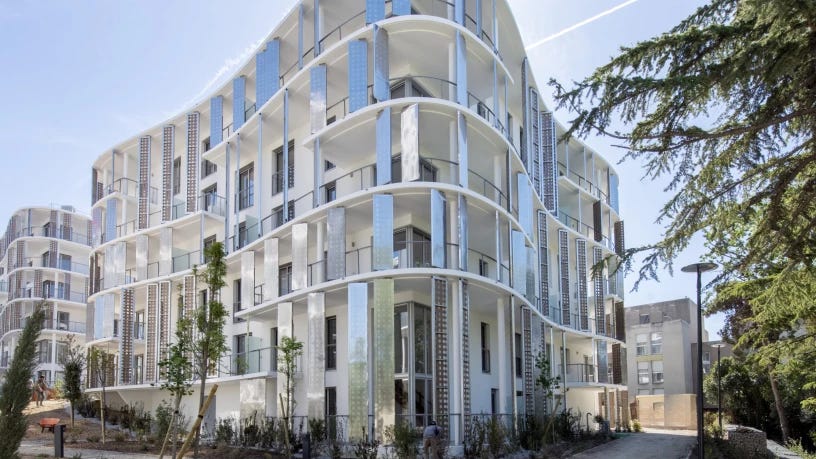
So the CDC funds almost all the debt behind social housing in France, and social housing is itself a quarter or so of new building. Right now it is a resilient quarter: the private, bank-financed market collapsed far faster than the social one.
Where does the money come from? Unique access to French savings.
Livret A
The CDC manages the centralised share of the Livret A, the tax-free, State-guaranteed savings account held by most French residents, along with its sister product the LDDS. By law, 59.5 per cent of those deposits sit with the CDC. At the end of 2025 the fund held about 453 billion euros.
The cost of that funding tracks the return paid to savers, currently 1.5 per cent. When the Livret A rate rises and the funding gets expensive, the CDC can lend from other resources instead, including the European Investment Bank and the Council of Europe Development Bank.
This is patient capital. The loans run to 40 years, sometimes 80. They are priced by the goals of the project, social or ecological, not by the borrower’s credit standing. So a small social landlord in the Creuse borrows at the same rate as a large one in Paris. It is not money chasing a double-digit return and an exit in five to seven years.
When the private market stalls
The CDC’s patient capital becomes decisive in a downturn. As private development collapsed from 2023, the State called on the group’s public-interest property company, CDC Habitat: France's largest landlord, which develops, acquires and holds housing at scale.
CDC Habitat committed to buy 17,000 homes off-plan from private promoters, with Action Logement, the employer-funded housing body, committing to up to 30,000 more. CDC Habitat alone placed orders worth around 2 billion euros across dozens of developers, keeping their sites alive. It kept buying, at a tapering rate, through 2024.
Note the division of labour. The lending runs through the Caisse and its Banque des Territoires. The off-plan buying runs through group’s property company, CDC Habitat. Same group, two roles in housing delivery.
The French advantage
Dublin, Amsterdam and Berlin all have institutions that, between them, could do what the CDC does: channel savings into housing, lend long, hold assets, steady the market in a slump. But the functions sit in separate agencies, with separate mandates.
France’s advantage is that these jobs sit in one balance sheet. Guaranteed household savings on one side. Forty-to-eighty-year housing loans on the other. Because that money is household savings, not market borrowing, it does not dry up when markets freeze, so the CDC keeps lending when the banks pull back.
The high-quality apartments that keep appearing in France rest on something quite simple: a regulated savings product, its proceeds lent at decades-long maturities and below-market rates.