


French apartments for sale “en BRS” turn up in my social media feed all the time. In the first week of November alone, Nexity issued a press release on its BRS commitments and Le Figaro ran a feature on how the formula is winning over both modest-income households and developers.
Bail réel solidaire (BRS) is an affordable land lease. The “buyer” buys the building but leases the land.
Despite the media spotlight, BRS is a small part of what France builds. Between 1,400 and 1,750 BRS homes were completed in 2024, depending on whose count you use. Mainland France started 253,300 homes that year.
In this article I’ll explain how BRS works, who builds it, and why I think it’s not so much affordable “home ownership” as a third way between owning and renting.
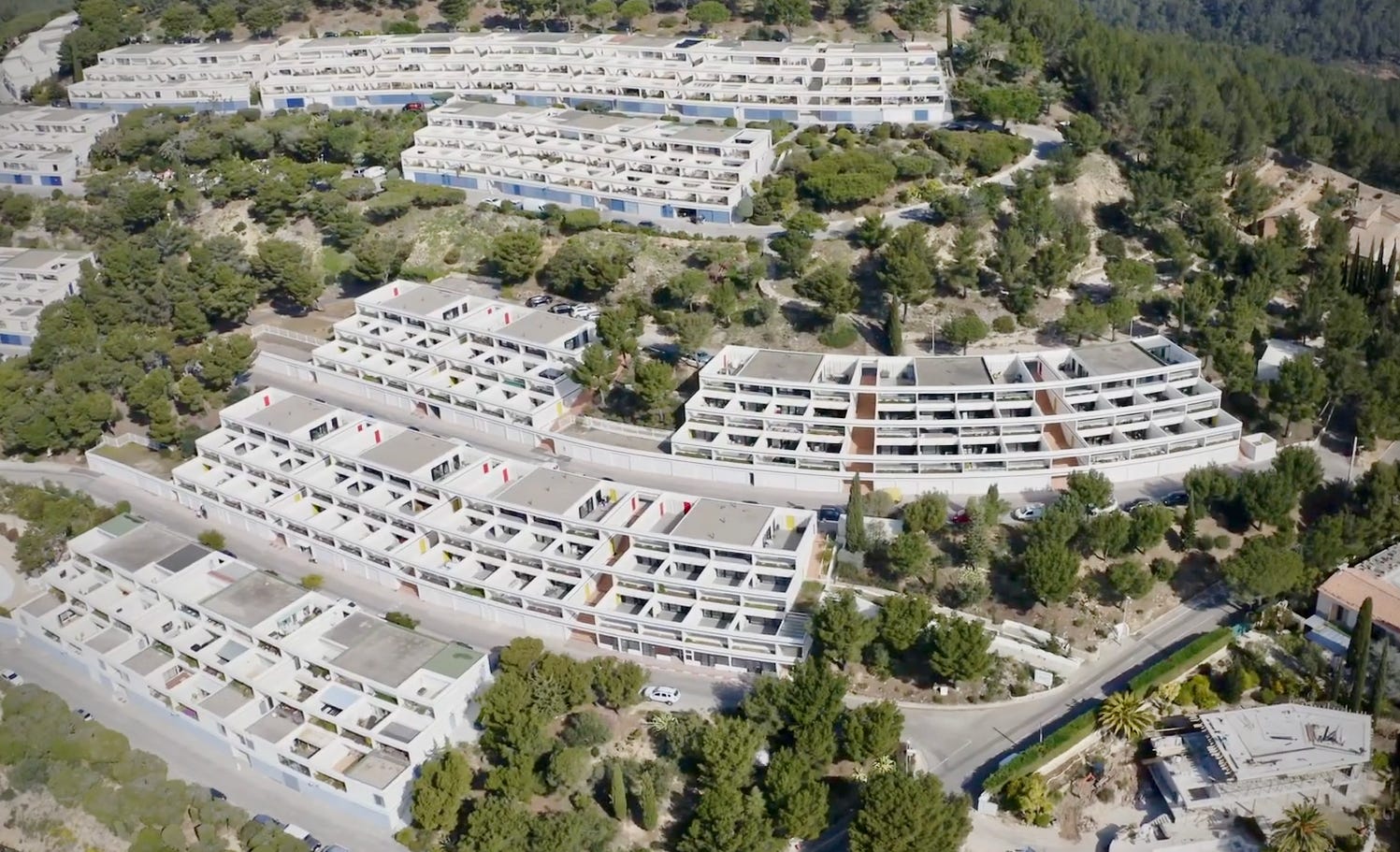
How it works
BRS splits a home into two parts: the land and the building.
The land is bought and held permanently by an organisme de foncier solidaire (OFS), a non-profit or limited-profit land body approved by the regional prefect. OFS are typically set up by social landlords, housing cooperatives or local authorities.
The household buys only the rights to the building, under a lease of between 18 and 99 years. It pays the OFS a monthly land fee, the redevance, averaging about €1 per square metre, or about €2 in Paris. In return, the purchase price is typically 30% to 50% below the local market.
The conditions are strict. Buyers must be under an income ceiling and live in the home as their main residence. When they sell, the price is capped by a formula and the buyer must also be eligible. The lease period then resets to its full length for the new household, so the new occupant gets the benefit of a full lease duration.
The developer’s role is similar to a normal off-plan property sale. In one scenario, the developer brings the site, sells it to the OFS and builds the housing under an operator lease. Another possibility is that the OFS already owns the land and tenders for a developer. In both cases, the OFS is committed before the planning application, and the households buying the homes only pay for the building, never the land.
Three sources of public money make the land affordable:
The Banque des Territoires, the lending arm of the Caisse des Dépôts that I wrote about here, lends the OFS the money to buy land over several decades. It lent €120 million for BRS in 2025, twice the 2024 figure.
Action Logement, the employer-funded housing body, lends OFS up to €15,000 per BRS home for land at a subsidised fixed rate. It also gives developers short-term construction loans and grants.
Local authorities guarantee the OFS’s long-term loans, which is what opens the Caisse des Dépôts loans to them. Many also sell public land to OFS at a discount, some for a symbolic euro, and can vote to cut the property tax on BRS homes by 30% to 100%.
Why France needed it
France already had a subsidised route to home ownership: the prêt social location-accession (PSLA), created in 2004. A PSLA household moves in as a tenant and pays a monthly charge that combines rent with savings. It can then buy the home outright, land included, at a reduced price fixed at the start.
PSLA had two weaknesses.
The first is that only the first occupant gets the benefit of lower-cost housing. The anti-speculation clauses in a PSLA sale expire after a set period. After that, the household can sell at market price and keep the gain, and the next buyer pays full price. The UK learned the same lesson with Right to Buy: research by the New Economics Foundation found that 41% of council homes sold under the scheme are now being let on the private rental market.
The second is land. A PSLA buyer still pays for the land, and in expensive cities that limits how low the price can go.
BRS addresses both. Because the OFS keeps the land permanently, the discount stays with the home through every resale, and taking out the land is what produces the deeper discount. Created by the ALUR law of 2014 and an ordinance of 2016, BRS also gave councils an incentive: since 2019, BRS homes count towards a commune’s social housing quota under the SRU (Solidarity and Urban Renewal) law.
The fine print
BRS is marketed as accession à la propriété, access to home ownership. I think that obscures how the mechanism restricts some of the property rights we’d expect from home ownership.
A BRS buyer holds a secure, registered right to occupy the building, which can be sold, mortgaged and inherited. But most of what makes ownership valuable stays with the OFS. BRS is better understood as a third tenure between renting and owning. Five points are the most likely to be misunderstood.
What you own. You own rights to the building for the length of the lease, never the land. The monthly land fee is paid on top of any mortgage, for as long as you live there.
What you gain when you sell. The resale price is capped by a formula set in the lease. If the neighbourhood gentrifies, or a new metro station opens nearby, the gain stays with the home for the next eligible buyer, not with you. What you take away is your repaid capital and a modest indexed increase.
Moving away. The home must remain a main residence, which French law generally defines as occupied at least eight months a year, with exceptions for work, health or force majeure. It can’t be used as a holiday home or an investment. Since 2024, the property can be let for a stated period, after notifying the OFS, unless the lease forbids it, but it must remain the owner’s home.
Selling. A buyer must meet the prevailing income ceiling and be approved by the OFS. That narrows the pool of buyers and can slow a sale. The backstop is the OFS’s guarantee to buy the home back if no buyer is found. This part of the system has barely been tested: only 21 BRS homes had been resold by the end of 2024.
Passing it on. Heirs who meet the same income and residence conditions take over with a fresh full-length lease. Those who don’t have twelve months to sell to an eligible buyer at the capped price; failing that, the OFS buys the rights back. The heir only gets the capped value, not market value.
None of this makes BRS a bad deal. For a household on a moderate income in Paris or Lyon, priced out of the open market and planning to stay put, it can be the only route to a secure, stable-cost home of its own. Compared with renting, it offers security and a capital sum at the end. Compared with owning, it costs much less, but the restrictions should be carefully considered.
The market share
BRS is growing fast from a small base. By the end of 2025, Foncier Solidaire France, the network of OFS, counted 7,280 BRS homes completed since the first ones in 2017, and a further 25,800 committed or in the pipeline.
Annual figures are harder to pin down. Completions in 2024 came to between 1,400 (the OFS network’s count) and 1,750 (the ministry’s). Against 253,300 homes started in mainland France that year, that’s 0.6% to 0.7%. The figures compare completions with starts, so treat them as an order of magnitude.
A better guide to the current pace is financing. The Banque des Territoires financed 4,200 BRS homes in 2025. That’s at least 1.6% of the 258,100 homes started in mainland France, and a floor rather than a total, since some OFS borrow elsewhere.
Compare that with the private developers’ market. In 2025, France’s private developers took 92,352 reservations, the signed off-plan sale contracts that come before a deed of sale. Even if every BRS home financed that year was delivered through a private developer, which most are not, BRS would come to only around 5% of their sales.
BRS is so visible partly because it’s one of the few parts of new housing development that’s growing, and partly because every scheme is a public story, with a local authority, developer or social landlord all keen to announce it.
Who builds it
BRS is delivered in two strands: via social landlords and private developers.
The social strand is the larger. Of the 7,280 BRS homes completed by the end of 2025, social landlords developed 4,074, or 56%, and OFS acting as their own developer about 635 more. Together that’s roughly two-thirds.
The private strand accounts for most of the rest. Private developers delivered 2,058 BRS homes, or 28%. A further 234 came from co-development, where a private developer and a social landlord set up a joint single-project company (usually a société civile de construction-vente, or SCCV) to develop a scheme together. Joint schemes are growing: they account for 3% of completed BRS homes but 10% of the pipeline.
The private strand is still young. Nexity, France’s largest developer, only completed its first BRS scheme, eight homes in Villeurbanne, in 2023. By November it had passed 2,100 BRS homes committed across 114 schemes, but more than half are still in development. Icade’s goal of selling 10% of its housing output as BRS is, for now, a target.
On the social side, BRS is catching up with PSLA rather than replacing it. Among France’s housing cooperatives, BRS sales rose from 240 in 2021 to 1,183 in 2025, while PSLA purchases slipped from 1,728 to 1,587. As of last year PSLA was still the larger of the two.
Why hasn’t BRS replaced PSLA after a decade? It took time to build the machinery. Each OFS needs state approval, its own finance and land, and then a scheme takes three or four years from planning to completion. Fewer than 100 BRS homes had been completed by the end of 2020. PSLA also still works well where land is cheap, so the land discount weighs less. The two have settled into a rough division: BRS in high-cost cities and PSLA in lower-cost areas. Some 97% of BRS homes are in France’s three highest-cost housing zones.
Who is it for?
The income ceilings are already generous relative to the median income: in 2026, €38,844 of taxable income for a single person in the highest-cost areas.
When the Senate voted during the 2026 budget debate to raise them to the level used for intermediate rental housing, about 15% higher, the government objected that existing ceilings already covered more than 80% of the population. Opponents in the National Assembly argued that raising the income ceilings further risked crowding out the modest-income households that BRS was designed for.
Either way, most households qualify, so access is rationed by the supply of BRS homes, not by income.
What it means for developers, investors and buyers
For developers, BRS is mainly a planning tool.
Councils, particularly those short of their SRU social housing target, write social-mix rules into their local plans and development-zone briefs, requiring a share of affordable homes in new schemes.
Because BRS counts towards the SRU quota, a developer can often meet part of that requirement with BRS homes sold to individual households, alongside the social rental homes sold in bulk to a social landlord. BRS has become one of the ways new schemes can stack up, financially and in planning terms. It also brings in buyers at a time when private investors, once the backbone of off-plan sales, have pulled back sharply.
For investors, BRS homes cannot be bought to let. Their relevance is indirect: a BRS component can help a mixed scheme they are buying into secure its permit and a share of its pre-sales.
For households, BRS offers a secure home at a capped price. It’s not a way to build wealth through property.
The model is similar to community land trusts in the UK and US, which separate land from buildings for the same reason. France’s difference is scale: patient state-backed finance, and a social housing quota that gives every council a reason to want it.
Judged as home ownership, BRS looks restrictive. It is best considered as a third tenure, combining ownership-style security with limits on how the home is used, sold and passed on. BRS fills a real gap, as long as buyers understand what they’re signing up for.